
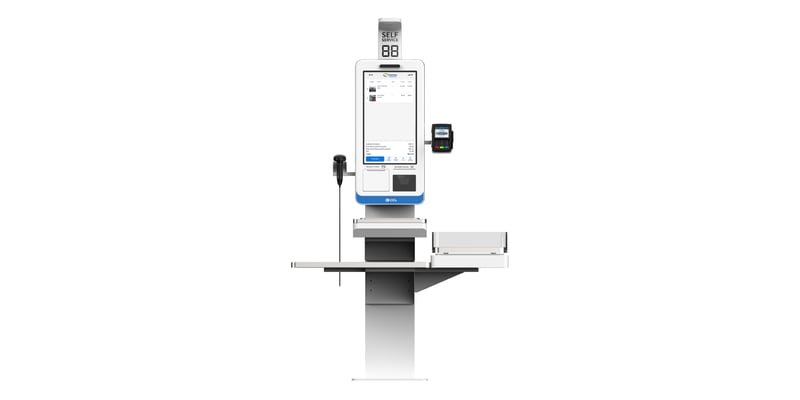
The Reckoning is Over. The Real Question is What You Buy Next.
The self checkout reckoning has settled, and the verdict is clear: the concept was never the problem. As I argued in The Self-Checkout Reckoning, the same kiosk that drove shrink and frustration for one retailer drove faster exits and bigger baskets for another. The difference came down to architecture and the technology control it gives the retailer.
That leaves retailers with a practical question. If architecture is the answer, how do you actually evaluate a self checkout solution? Customer adoption is no longer the issue. 43% of consumers now prefer self checkout, rising to 63% among shoppers aged 18 to 29, and nearly 40% of U.S. grocery registers are already self-service. The decision is not whether this service is of value to your customers. It is which solution gives you the control to make the experience work in your environment and the agility to continuously improve.
"A self checkout solution is not a one-time purchase. It should be a platform you will iterate on for a decade. Evaluate it on the experience control it gives you through composable tools and autonomous UX generation."
-Abhijit Killedar, CTO, OneView Commerce
Introducing the Self Checkout Evaluation Framework
This is the practical companion to the Unified Checkout Model. While that framework explains why architecture determines self checkout success, this one provides technology leaders four criteria to evaluate before committing: Control, Convertibility, Insight, and Total Cost of Ownership. Each maps directly to a capability of the underlying platform, and each separates a solution that empowers continuous innovation versus one that is only as good as its iniital deployment.
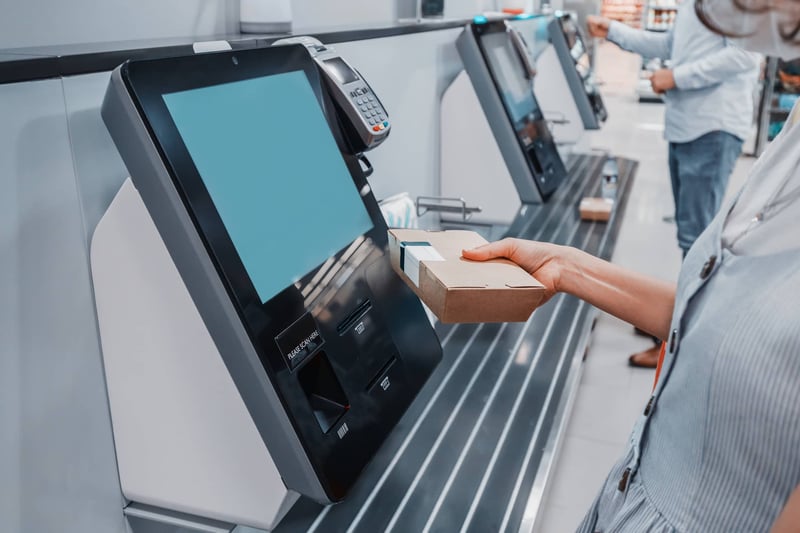

What Is the Self Checkout Evaluation Framework?
The Self Checkout Evaluation Framework is a structured way to assess self checkout solutions against four criteria (Control, Convertability, Insight and Total Cost of Ownership) that align retailer experience goals with the composable, API-first architecture required to deliver and continuously improve them.
The Framework at a Glance

| Evaluation Criterion | What to Look For | Outcome |
| Control | Headless, API-first point of sale capabilities that enables independent composability for retailers | You own the experience and shrink logic, instead of depending on a vendor's default settings |
| Convertability | Single codebase that flexes self-service to assisted lanes in seconds | No peak-hour bottlenecks; floor space that adapts on demand |
| Insight | Actionable intervention, shrink and basket analytics per lane | Continuously reduce friction and less with data, not guesswork |
| Total Cost of Ownership | Powerful out-of-the-box functionality on composable architecture enables fast time to market and experience extension to fit your brand | Lower lifetime cost; deliver powerful improvements iteratively to avoid costly and risky rip-and-replace |
To deploy solutions that deliver on promises and scale, retailers should evaluate self checkout against these important criteria.
.jpg?width=600&height=558&name=SCO%20Analytics_3%20(2).jpg)
Criterion 1: Control Over the Checkout Experience
The Importance: In its last full accounting, NRF put U.S. retail shrink at $112.1 billion, or 1.6% of sales, with internal and external theft responsible for roughly two-thirds of it. A large percentage of that loss is won or lost in the scan flow and loss-prevention logic of the checkout lane. Without composability, you are limited to the vendor's parameters only. The retailers winning at self checkout treat the user experience as a product they own. That is only possible when the solution runs on a headless, API-first point of sale that your team can extend and tailor at the store, zone, or transaction level.
What to evaluate:
- Confirm the solution runs on a cloud-native, headless, API-first point of sale platform so your team can take ownership of the user experience as desired, without vendor dependency
- Verify you will have control to adjust audit and loss-prevention logic by store, zone or transaction with composable experience control that does not depend on the vendor
- Confirm that AI-powered item recognition and skip-scan detection can be configured by risk profile
- Verify offline-first functionality and configuration on how lanes maintain operation should connectivity drop
Without control, your boundaries are defined by the vendor's roadmap instead of your own.
Criterion 2: Convertibility for Demand that Shifts
Store traffic fluctuates. A fixed self checkout does not provide a return on high-value floor space when it cannot adapt. For maximum adaptability, the ability to convert a self-service lane into a full-service, associate-driven lane in seconds positions your stores to best adapt to shoppers' needs. As a single-codebase platform, OneView will switch modes almost instantly to allow the flexibility to offer self-service when it makes the most sense.
What to evaluate:
- Verify that you are selecting a full-range point of sale platform built on a single-codebase to ensure both deployment flexibility and the ability to instantly convert from self-service to associate-assisted checkout
- Confirm important functions, like age and product verifications, are handled in-flow with the ability to create maximum flexibility to the customer experience
- Require a single point of sale platform that can support mobility, self-service and fixed lanes on the same platform to enable cohesion across your store experiences, data accessibility and streamlining of UX efforts so every extension can be deployed regardless of the modality
- Demand hardware flexibility so that you are not locked into a single deployment option and can adjust hardware decisions as needs evolve
Without convertibility, every peak-hour bottleneck can become an abandoned basket.
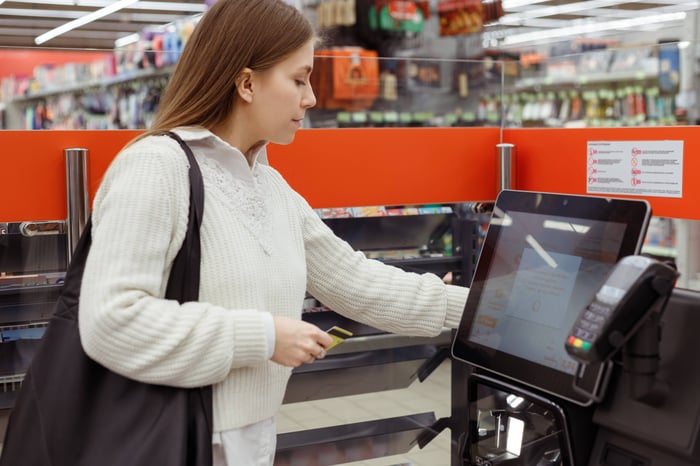
Criterion 3: Insight You Can Act On, Not Just Dashboards
A dashboard that reports yesterday's problems is not strategic insight. The value is in a closed loop where data is available across your ecosystem to drive changes you can measure. In its April 2026 report Shopping in the Age of AI, McKinsey and ICSC argue that store technology earns its return not when it simply collects data, but when it gives managers the visibility to make better decisions. On the loss-prevention side, IDC projects that by 2028 half of large retailers will expand computer vision for store monitoring, reducing shrinkage by as much as 40%. Both gains depend on analytics your team can act on in real time.
What to evaluate:
- Confirm the platform’s flexibility to track key metrics such as intervention type, frequency, duration, and multi-request rate per lane
- Ensure access to shrink analytics that can feed directly into configurable loss-prevention controls
- Look for lane-level metrics such as basket size and throughput metrics
- Insist on a continuous data loop: insights that can drive configuration updates and then measurement of the result
Without actionability in the analytics, you are collecting data you have no way to use.
Criterion 4: Total Cost of Ownership Over the Deployment Lifecycle
While self checkout can reduce checkout staffing costs by up to 40%, the sticker price tells you almost nothing about the true cost of ownership. Most legacy solutions require custom development, integration overhead, slow release cycles that leave you open to shrink exposure that comes from a lack of adjustability and adaptability. True total cost of ownership weighs the full picture across a three-to-five-year horizon. This is where composability shines -- every iteration delivers more value at less cost when you are leveraging a single platform for cross-functional execution.
What to evaluate:
- Prioritize out-of-the-box enterprise functionality with extensibility of a composable foundation to eliminate expensive custom development
- Favor smaller-footprint, hardware-flexible formats that optimize store layouts and reduce time-to-market
- Require a cloud-native platform that offers continuous delivery of your small iterative improvements. This ensures each improvement is an isolated change, not a system-wide upgrade
- Model TCO across three to five years, including shrink, intervention labor, and the cost of creating and delivering your brand-specific experiences
Without a true TCO lens, a low-cost self service deployment can quickly become the most expensive decision for your business.
Why Composable Architecture Is the Common Thread
Every criterion in this framework traces back to the same foundation. Control, convertibility, insight, and total cost of ownership. These are not independent features you can shop for separately, but are the outcomes of the architecture underlying a self-service delivery. A composable, unified commerce platform delivers all four because it provides:
- Microservices-based flexibility: modify one function without disrupting the rest
- API-first integrations: connect best-of-breed AI, payment, and loss-prevention tools
- Real-time data accessibility: act on what is happening in the store now, not yesterday
- Full offline support: critical for self-checkout continuity in any network environment
- Continuous delivery: identify a key pain point, deploy the solution for that targeted objective while you build, test and learn to maximize value from your transformation
Choosing a self checkout solution is, in practice, committing to a long-term architecture. Evaluate it accordingly.

Turn the Framework into Measurable Proof
Define, Validate, Scale
Retailers navigating the self checkout decision need proof, not just vision. With a modern point of sale platform, you gain the ability to continuously validate the four criteria in real-world settings as you iterate the solution. With this as the basis for your enterprise rollout, you are informed and prepared to:
- Deploy modern self checkout in a controlled environment against measurable baselines
- Quickly validate key functions like configurable shrink controls against real transaction data
- Validate lane convertibility and Scan & Go against your actual peak-traffic conditions
- Build a broader transformation business case with real ROI data and proven TCO timelines
Confidence and capability go hand in hand. Start with proof. Scale with confidence.
Validate Your Self Checkout Evaluation Framework
Modernize your Point of Sale, Inventory, and Promotions in a targeted, measurable environment. Explore OneView’s Fast-Start program to prove ROI before an enterprise rollout. Start with proof. Scale with confidence. Start Here.
Frequently Asked Questions about Choosing Self Checkout
What should retailers evaluate when choosing a self checkout solution?
Evaluate against four criteria: Control (can you extend the experience and important functions such as loss-prevention logic yourself), Convertibility (can lanes flex between self-service and assisted), Insight (does the platform give you actionable per-lane analytics), and Total Cost of Ownership (what does the solution cost to run, enhance and extend over three to five years, not just to install).
How is modern self checkout different from a legacy option?
Modern self checkout runs on a composable, API-first point of sale platform that includes real-time inventory, promotions, and ready access to the data that will power important tools like AI-driven loss prevention. Unlike traditional legacy implementations, modern self checkout is continuously configurable, so retailers can adjust controls, formats, and workflows without vendor dependency or long release cycles.
Can self checkout expose the business to increased theft?
It can when controls cannot be adjusted. A January 2026 LendingTree survey found 27% of self checkout shoppers admit to intentionally taking an item without scanning it, and 55% of them say they plan to do it again. But a modern platform can support important tools like integrated AI computer vision and trust-level auditing to let retailers substantially reduce that exposure while keeping the experience frictionless for the majority of shoppers.
What is the ROI and total cost of ownership of self checkout?
Self-checkout can reduce checkout staffing costs by up to 40% and processes transactions roughly 30% faster than staffed lanes. But actual ROI has to factor in shrink, intervention labor, and the total cost of deploying the system across the estate. A composable platform improves ROI by injecting agility and iteration into the solution and putting retailers in control of extending experiences, leveraging autonomous UX development and using continuous delivery to ensure new features are isolated improvements, not vendor-dependent projects that require long, complex test cycles.
What role does composable commerce play in self checkout?
Composable commerce is what makes all four evaluation criteria achievable. Its API-first, microservices-based architecture provides the cloud-native framework that connects self checkout from the POS infrastructure to real-time inventory, enterprise promotions, loyalty, and loss prevention, and gives retailers the control to keep improving the experience as business and customers require.